PhD
Planet formation in multiple stellar systems
supervised by
Nicolás Cuello, François Ménard
as part of the
Stellar-MADE ERC projectat
Institut de Planétologie et d'Astrophysique de Grenoble, Grenoble, FranceContext
When stars form, material accumulates in a disc in their surroundings. The fraction of dust contained in that material eventually grow into planets over hundreds of thousands of years, making the disc called 'protolpanetary'. One can easily imagine that how this growth occurs depends on the properties of the protoplanetary disc : for example, more massive disc are thought to form massive planets. But this growing phenomenon also depends on the disc dynamics, ie on how the disc moves : for instance, a 'turbulent' disc will result in high-velocity collisions between dust particles, preventing their growth. Then, understanding protoplanetary disc dynamics is then a key step to understand how planets form.
It is now commonly accepted that stars are born multiples, namely in pairs of two, three, four, or even more. And if the planet formation process seems well understood for stars in isolation, everything becomes complicated when it comes to multiple stellar systems. As a first consequence, you can now have a protoplanetary disc around any star or group of stars of the system. A disc around one star, and another around two stars ? No problem, you can combine the configurations to make it more fun. As a second consequence, in multiple stellar systems several kinematic effects resulting from the star-disc gravitational intractions are expected to modify the disc(s) dynamics. It produces substructures inside the disc(s) and modifies the local planet formation conditions as a result.
Aims
How is the planet formation process shaped by stellar multiplicity ? What are the planet formation sites in multiple stellar systems ? What are the dust properties in multiple stellar systems ?
My first goal is to characterize discs in typical multiple systems both observationnally and numerically to assess their dynamical response to stellar multiplicity. Comparing actual observations to numerical simulations (Hydrodynamical+Radiative Transfer), I aim to understand to what extent multiplicity shapes disc morphology and dynamics in young stellar systems.
Once the dust dynamics properly understood, the second step is to understand to what extent these dynamics impact the dust growth. In order to do so, I will use a combination of hydrodynamical simulations and dust growth algorithm, processed with a radiative transfer code. In this way, I will highlight the regions where dust particles either fragment or agglomerate, and thus the favored regions for planets to form in multiple stellar systems.
Methods
To have insights on how the planet formation process occurs, one first need to observe actual system to obtain data. These data will then be used to constrain (analytical or numerical) models. Then, observations and modelling need to work in concert to fully understand how planets form.
Observations
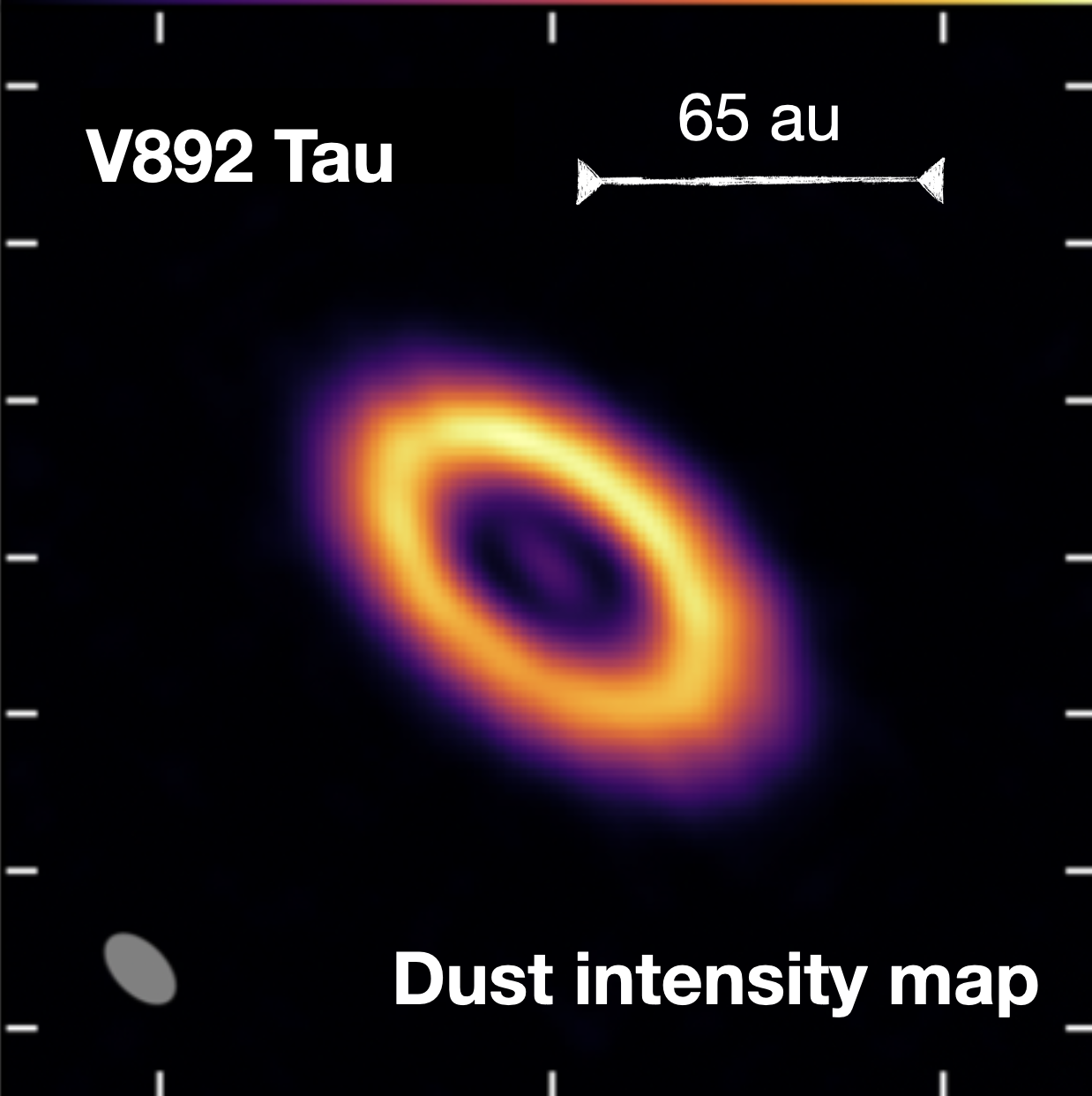
With a typical radius of around 50 astronomical units, protoplanetary discs are monstruously large. However, given the enormous distance at which they stand from Earth, protoplanetary are not easy to clearly see. In order to solve that problem, one needs angular resolution. And when you have a telescope, the bigger the mirror, the greater the angular resolution. But at the level of details needed to resolve the protoplanetary disc, and if you want to see the dust emission directly, one would need kilometer-large mirrors...
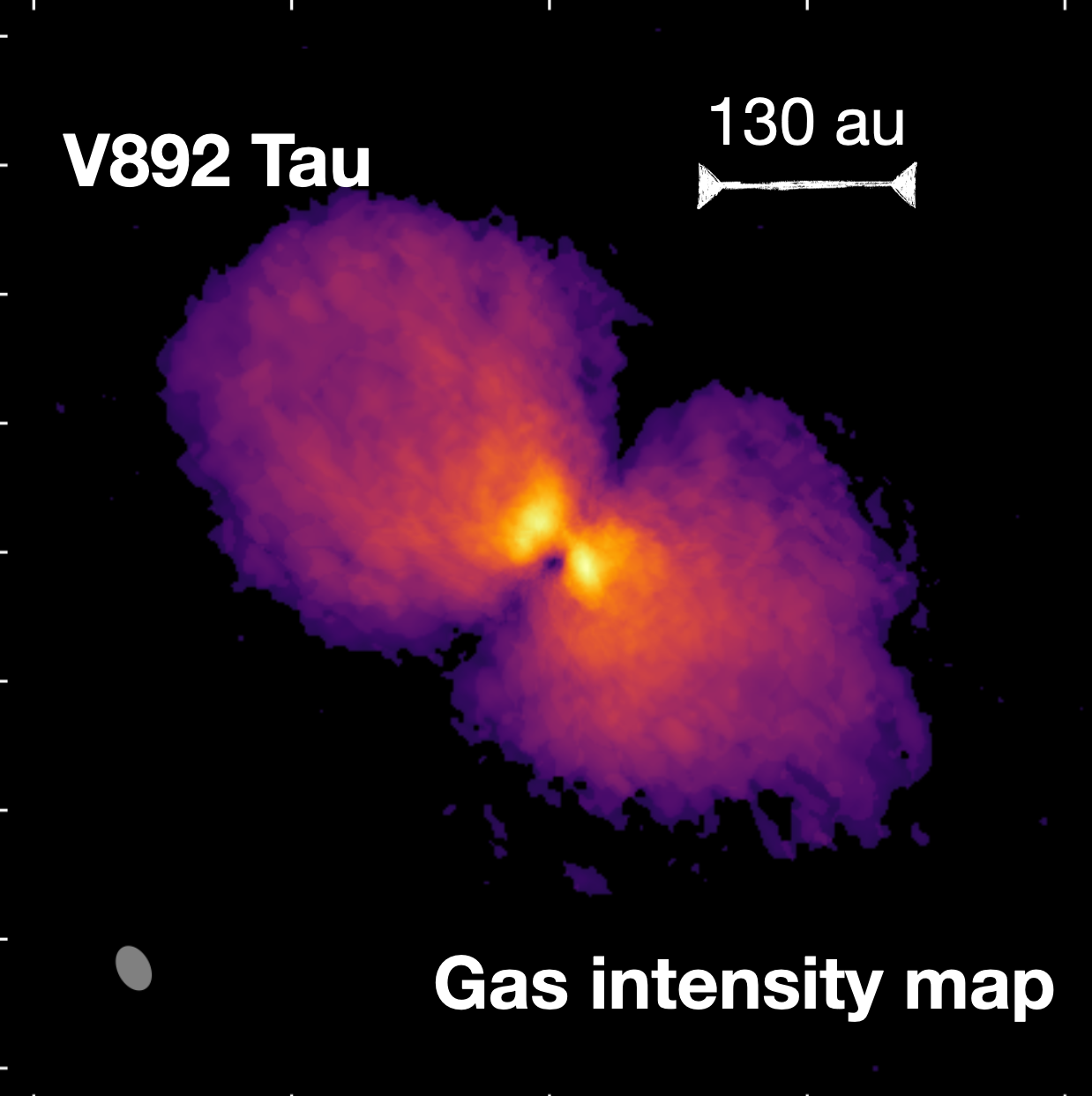
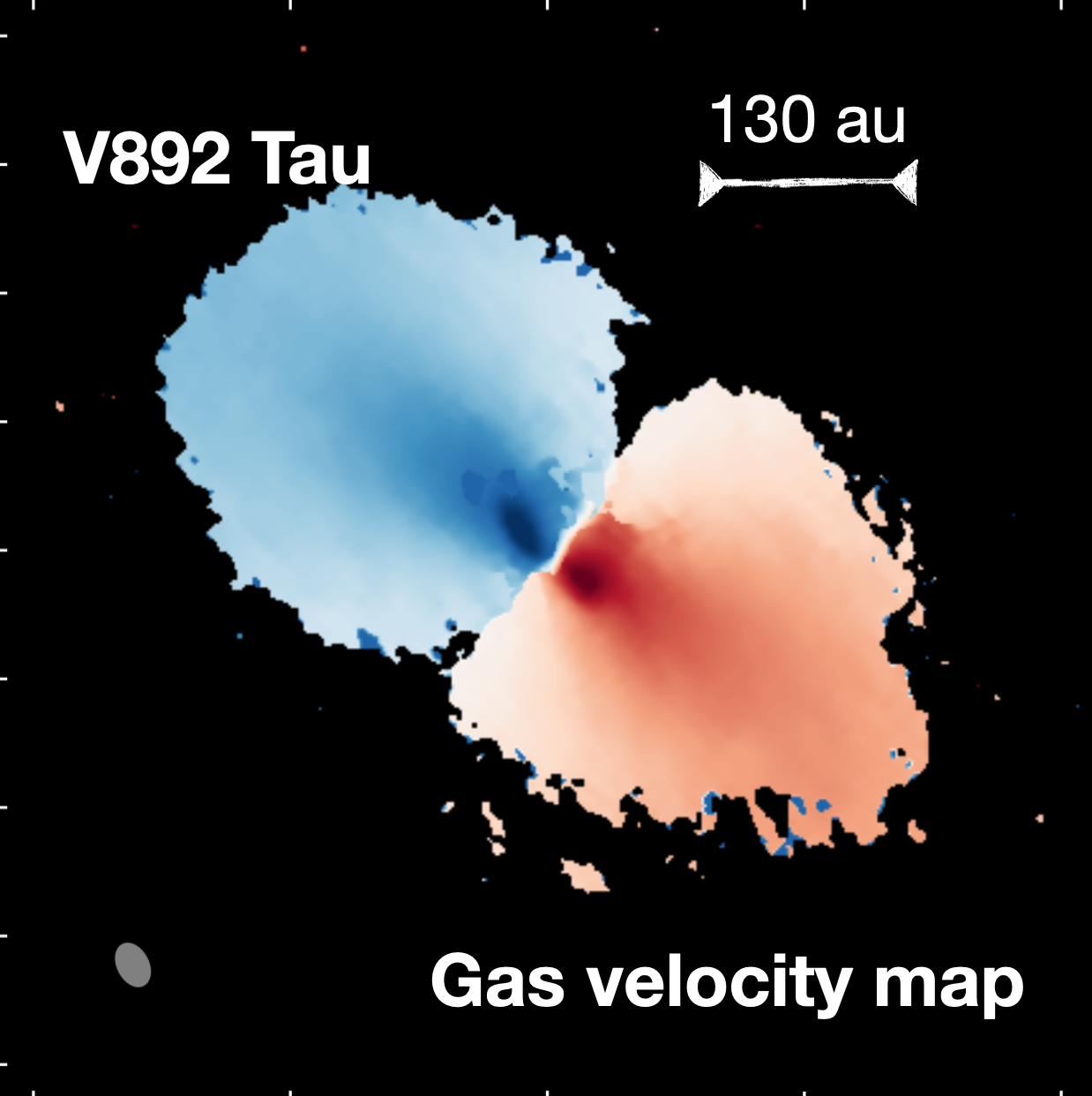
Fortunately, instruments such as the Atacama Large sub-millimeter/Millimeter Array (ALMA) allow to mimic the effects of such large mirrors thanks to the interferometry technique. ALMA is a wonderful instrument, and one of primordial importance for the study of protoplanetary discs. Not only it offers the best angular resolution in the world, but it also allows to study multiple aspects of the discs at once. Indeed, with ALMA you can image the dust emission of a young stellar system, but you can also have access to the emission of molecular gas. And as molecular gas emission heavily depends on the local gas velocity, it creates a direct access to the kinematics of the protoplanetary disc.
This is why I will use ALMA archival data and ask for new ALMA data during my PhD. Targetting young multiple systems of relevance, I hope to shed light on protoplanetary discs dynamics in these systems.
Numerical simulations
The bulk of the disc dynamics in a single star systems is fairly well described by a set of differential euqations that can be solved analytically under reasonable assumptions. But when it comes to multiple stellar systems, the symmetry of the problem is broken which makes it way more difficult to solve. Indeed, characterizing the disc dynamics (impacted by the interactions with the stars) becomes a challenge that can be cracked for a few configurations of systems only (coplanar systems for example). If we want to unveil the disc dynamics in a diversity of multiple stellar systems, one has to solve numerically the equations of the disc (hydro)dynamics.
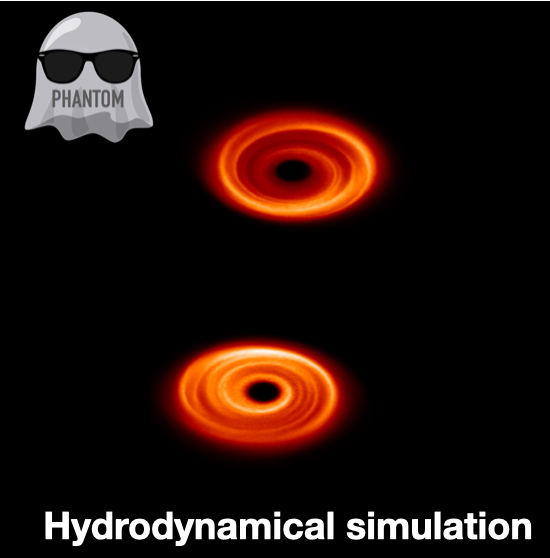
Many codes are designed to solve these equations, each in their own way. The code I will use is the code Phantom. It represents the disc (ie the fluid) as a collection of particles, each carrying properties like mass, velocity, and energy. These particles interact with each other (through smoothing functions, which average the properties over a defined region), allowing for the calculation of fluid properties like density and pressure. Phantom is particularly useful for modelling complex, dynamic, and asymmetric systems, such as young multiple stellar systems.
Using such codes allows to access the local and dynamical informations of the disc over time. Because discs evolve over millions of years, observations cannot grant some of these informations, but are only a snapshot in time. Hydrodynamical simulations unveil the dynamical evolution of systems. In the case of young multiple stellar systems, this allows to understand in details the interactions between the stars and the discs in the system, and the resulting structures they imprint in the discs.
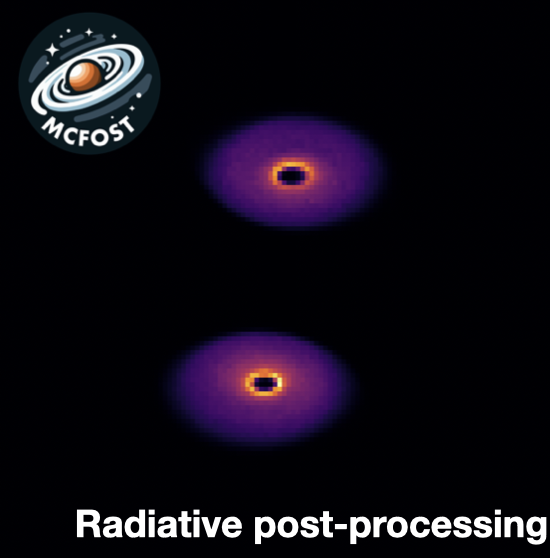
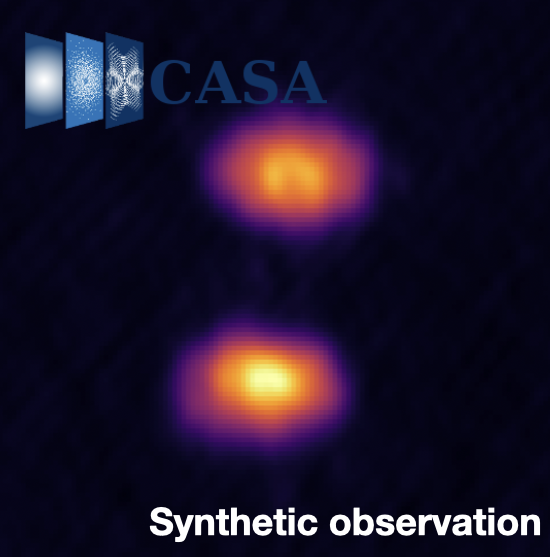
Finally, one can then post-process the outputs of hydrodynmical simulations to turn them into fake observations. It is done by using a radiative transfer code such as MCFOST to light up the stars, and then by adding the instrumental effects on the image with softwares such as CASA for example. Doing so, it allows for a direct comparison with actual observations.